
Synthetic Opal vs. Natural Opal: The Complete Buyer’s Guide
Nov 28,2025 | Juyoyo
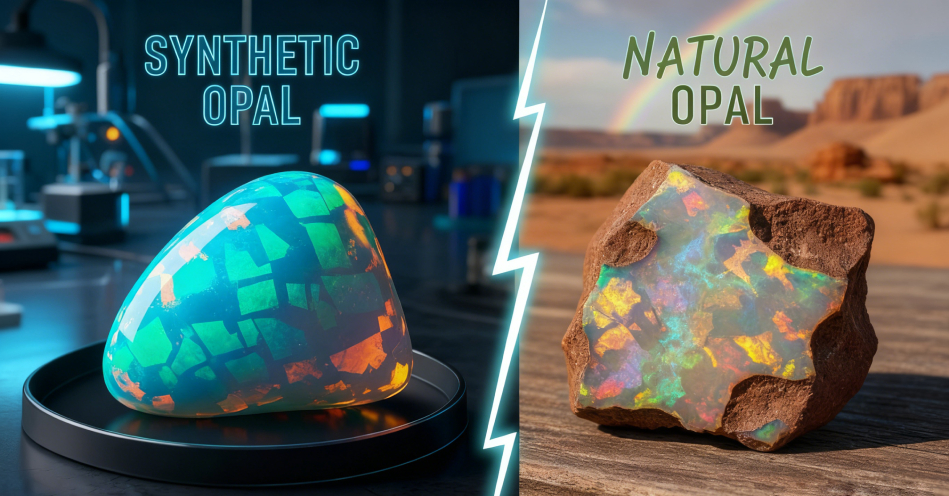
🔍 Key Takeaways: Synthetic vs. Natural Opal
- Natural opal forms underground over millions of years, creating unique patterns and colors. It is highly valued for its rarity and beauty, but it is also expensive and fragile.
- Synthetic opal (lab-created) is made in a laboratory using chemical processes that are similar to those used to make natural opal. It looks like natural opal, but it costs much less. It is more durable and affordable, and has a consistent pattern.
- Imitation opal is likely made of plastic or glass (like opalite). It contains no silica. Avoid it if you want a real gemstone.
- For Most Buyers: Choose natural opal if you value uniqueness and heritage, or choose synthetic opal if you want vibrant beauty, durability, and affordability.
For centuries, opals have mesmerized humanity with their dazzling play of color. But when shopping for opal rings for her, a common question arises: What’s the difference between synthetic and natural opals, and which should I choose?
At Juyoyo, we have over a decade of experience crafting exquisite gemstone jewelry. We believe that true luxury lies in empowering you with knowledge and transparency. Whether you’re buying an opal engagement ring or pendant or are simply curious about the differences, this guide will help you master the difference between synthetic opal vs natural opal, ensuring you spend your money wisely. Let’s dive in!
What Is Natural Opal?
Natural opal is a gemstone formed from silica dioxide and water. It is deposited over millions of years in rock fissures or sedimentary environments. Its signature play of color arises from the diffraction of light through tightly packed silica spheres stacked in an irregular grid.
Key Features of Natural Opal:
- Unique Play-of-color: Random silica spheres scatter light, creating one-of-a-kind rainbow flashes.
- Rarity: No two natural opals are identical.
- Value Factors: Rarity, body tone, brightness, and pattern type (e.g., harlequin or pinfire).
- Origin: Mined in countries such as Australia (Lightning Ridge black opals), Ethiopia, and Mexico.
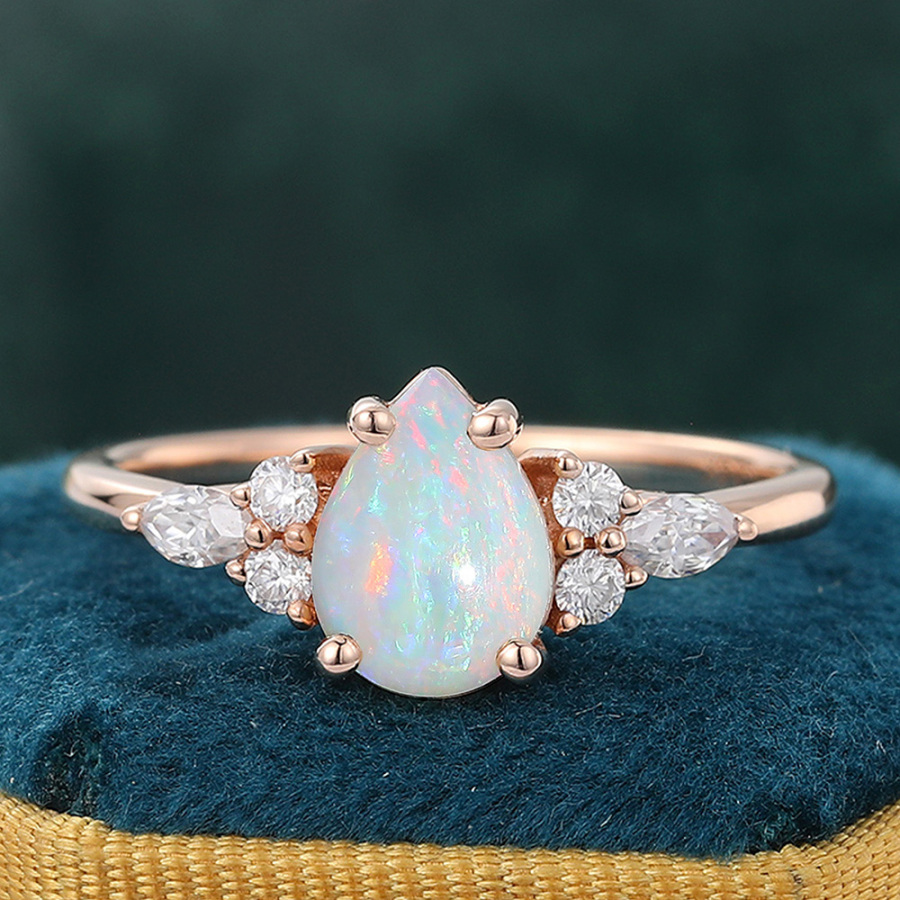 |
| Nature Opal Engagement Ring |
What Is Synthetic Opal? (It’s Not Just "Plastic")
Synthetic opal is technically "real" opal. It is often called lab-created or man-made opal. Unlike cheap plastic imitations, high-quality lab-created opals (such as the famous Gilson Opal) have the same chemical composition as natural opals: hydrated silica. Gilson introduced the first commercially successful synthetic opals in 1974, and their production techniques have evolved since then. Gilson Opal remains the industry standard for chemical fidelity and vibrant color.
Key Features of Synthetic Opal:
- Appearance: Vibrant colors, often more uniform.
- Durability: Engineered to resist cracking and dehydration.
- Affordability: It costs a fraction of natural opal.
- Ethics: Eco-friendly with no mining impact.
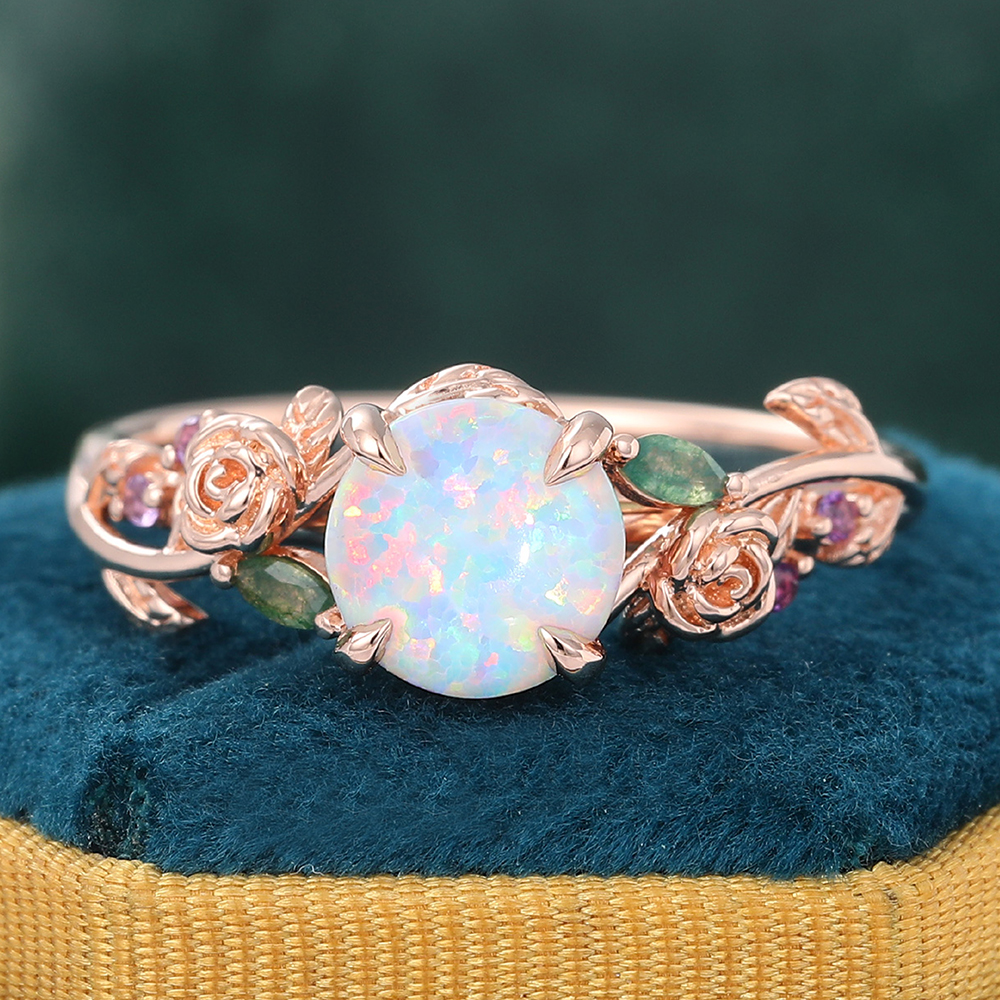
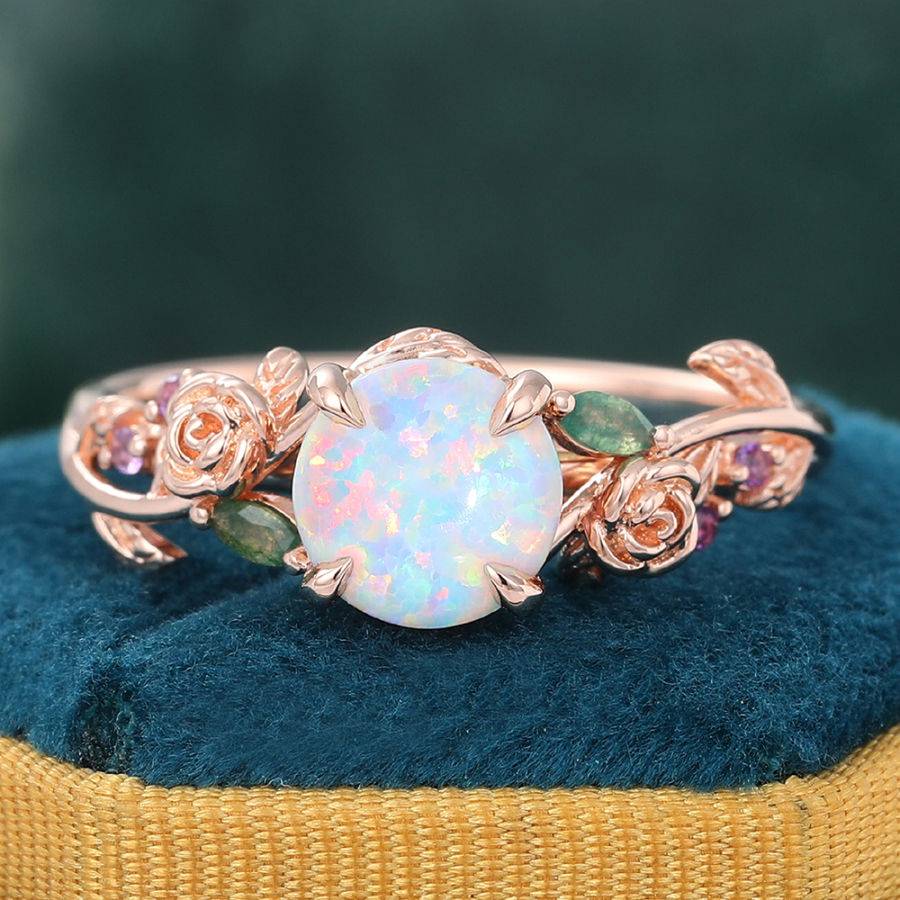 |
| Lab Grown White Opal Engagement Ring |
Synthetic vs. Natural Opal: Quick Comparison
Refer to this table for a quick, at-a-glance understanding of the core differences. We'll discuss more details in the sections below.
| Feature | Natural Opal | Synthetic Opal |
| Composition & Formation | SiO₂·nH₂O; formed over millions of years in nature. | SiO₂·nH₂O; created in a lab over weeks/months. |
| Appearance & Pattern | Unique, random, and flowing play-of-color; organic patterns. | Repetitive "lizard skin" or "honeycomb" pattern; too uniform. |
| Durability & Care | Softer (5.5-6.5 Mohs); prone to crazing in dry conditions; requires careful maintenance. | Generally tougher and more resilient; highly resistant to crazing; lower maintenance. |
| Value & Ethics | High value due to rarity and uniqueness; an investment; natural mining has environmental impact. | Low cost, accessible; no resale value; eco-friendlier controlled production. |
| Best For | Heirloom pieces, investment, collectors, and special occasions. | Everyday jewelry, fashion trends, budget-conscious buyers, and bold designs. |
Natural vs. Lab-Created Opal: Composition and Formation
Both natural and synthetic opals are primarily composed of silicon dioxide and water (SiO₂·nH₂O) at a chemical level. This shared composition explains why they can appear similar at first glance. However, the profound difference lies in how and how long.
| Feature | Natural Opal (Mined) | Synthetic Opal (Lab-Created) |
| Chemical Formula | SiO₂·nH₂O (Hydrated Silica) | SiO₂·nH₂O (Hydrated Silica) |
| Formation Time | Millions of years | 12 to 18 months |
| Growth Method | Natural sedimentation of silica-rich water | Controlled growth in a laboratory setting |
| Internal Structure | Randomly stacked silica spheres (Amorphous) | Perfectly ordered, uniform silica spheres (Regular Grid) |
| Stabilization | Contains natural water (3%–21%) | Often polymer-impregnated (resin) for hardness |
| Key Brand Example | Australian Black Opal, Ethiopian Welo Opal | Gilson Opal (The first and most famous brand) |
Natural vs. Lab-Created Opal: Appearance and Pattern
The real magic of opals happens in their appearance, where the differences between natural and synthetic opals become clear.
Natural Opal's play-of-color is as unique as a fingerprint, making each piece one-of-a-kind. Their patterns are organic and random, flowing seamlessly into one another. You may see broad, sweeping flashes of color; delicate pinfire spots; or the highly prized harlequin pattern, which features mosaic-like patches. These colors and patterns have a sense of depth and spontaneity, a direct result of the nonuniform size and arrangement of the silica spheres that formed over eons.
Synthetic opal often reveals its man-made origin through its distinctive patterning. The most recognizable clue is the “lizard skin” or “honeycomb” effect, where color patches form tightly packed geometric columns with sharp, uniform edges. This repetitive, almost too-perfect arrangement contrasts with the irregular play of color in natural opals. In addition, synthetic opals tend to show consistently vibrant hues from nearly every angle, while natural opals display a more dynamic fire that shifts dramatically with movement and light.
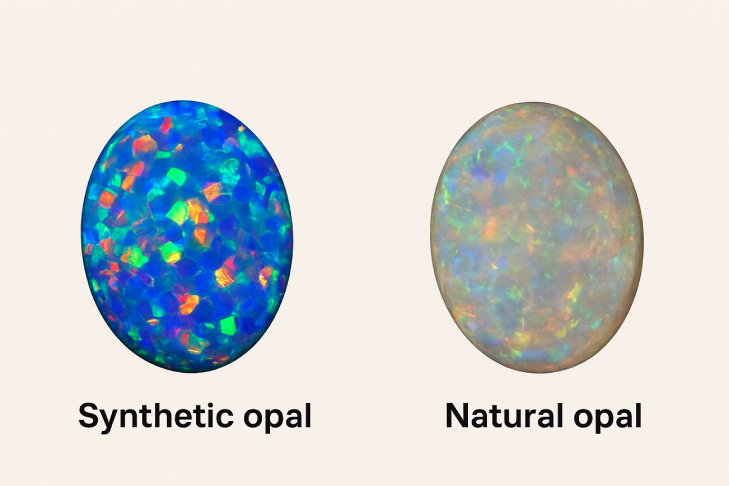
Natural vs. Lab-Created Opal: Durability and Care
This is the most important section for buyers. If you are buying opal dangle earrings, durability matters less. But for a ring? It's everything.
Natural opal contains water. It ranks low on the Mohs scale (5.5-6.5) and is sensitive to temperature changes and dehydration, which can cause "crazing" (internal spider-web cracks). Natural opal requires some care. To keep it in good condition, protect it from knocks, harsh chemicals, and extreme environments.
Most modern synthetic opals are polymer-impregnated, meaning resin is used to bind the silica structure and remove the stone's natural water content. This process makes the stone more resistant to cracking, chemicals, and sudden temperature changes. As a result, synthetic opals are harder than natural opals. Consequently, synthetic opals are more scratch-resistant and ideal for jewelry pieces that face frequent impact, such as rings and bracelets. While it’s still wise to avoid harsh chemicals and heavy impact, synthetic opals require less maintenance, offering peace of mind to active wearers who want beauty without constant worry.
Natural vs. Lab-Created Opal: Value and Ethics
For many buyers, the value proposition and ethical considerations of natural versus synthetic opal are perhaps the most decisive factors.
Natural opal is a treasure of the earth. Its value is determined by rarity, size, body tone, brightness, and unique patterns. For instance, a high-quality black opal from Lightning Ridge can cost between $500 and $10,000+ per carat. It is a store of value and a potential investment that can be passed down through generations. Ethically speaking, natural opal mining is generally small-scale and has a smaller environmental impact than diamond mining, though it still alters the landscape.
Synthetic opal answers the question, "Is synthetic opal worth anything?" with a clear "Yes, but differently." Its value is purely aesthetic and commercial. It has no resale value as a gemstone and will not increase in value over time. Think of it as buying a beautiful piece of furniture versus an antique: one is for use, and the other is for investment. Ethically, its lab-grown origin guarantees a conflict-free background and significantly reduces environmental impact, appealing to eco-conscious consumers.
At Juyoyo, we price our jewelry based on craftsmanship quality. Whether you choose natural or lab-grown stones, setting quality is always our top priority.
Continue reading: How Much is Opal Worth? Unveiling the Secrets to Opal Value
How to Identify Synthetic vs. Natural Opal
“How can I tell if an opal is real?” Here are the key differences that can be observed with the naked eye or simple tools.
| Feature | Natural Opal (Mined) | Synthetic Opal (Lab-Created) |
| Play-of-Color Pattern | Irregular, chaotic, flowing transitions. Unique fingerprints. | Highly uniform, repeated "lizard skin" or honeycomb pattern. |
| Internal Structure | Organic, amorphous. No visible columns. | Distinct columnar structure (vertical pillars) on the side. |
| Fluorescence (Short-wave UV) | Weak, patchy, or none (Depends on trace elements). | Strong, uniform, chalky green/white fluorescence. |
A. Look for the "Lizard Skin" or "Honeycomb" Pattern
When magnified, you’ll often see a distinctive "lizard skin" or "honeycomb" pattern on the surface or within synthetic opal. These color patches have sharp, well-defined edges and are arranged in a more regimented, column-like structure.
Natural opal displays color patterns that are softer and more flowing, with irregular, random shapes and blended color transitions.
B. Check the Transparency and Edge Definition
Synthetic opal often has a sharper, more defined edge between color patches. This is sometimes described as a "columnar structure."
Natural opal has a more seamless, organic play of color without that manufactured geometric appearance.
C. The UV Light Test (The Expert Check)
This reliable test helps high-end buyers determine if an opal is synthetic. Under short-wave ultraviolet (UV) light:
- Natural Opal: Typically shows little to no response or a weak, inconsistent glow.
- Synthetic Opal: Due to polymer stabilizers, most lab-created opals fluoresce with a strong, bright, uniform green or white glow.
Critical Confusion: Opal Doublet vs. Synthetic
One final trap to avoid: The opal doublet versus synthetic confusion.
- A doublet is a "sandwich" stone. It consists of a thin slice of real natural opal glued onto a black backing, usually ironstone or plastic, to make the color stand out.
- A synthetic is man-made through and through.
How to spot it: Look at the side of the stone. If you see a perfectly straight line separating the clear top from the black backing, it's a doublet. While doublets are a great, affordable option, they are vulnerable to water damage because the glue can separate. Synthetic opals are actually more waterproof than doublets!
How to Choose: Which Opal Is Right for You?
The debate between natural and synthetic opals isn't about which is "better." It's about which is better for you.
Choose Natural Opal If:
- You're looking for a unique investment piece or future heirloom.
- The gem's unique story and natural history are as important to you as its beauty.
- You're buying it for a significant occasion, such as an engagement or a major anniversary.
- Your budget is less of a constraint than rarity and long-term value.
Choose Synthetic Opal If:
- You need a beautiful, durable stone for everyday wear, such as opal rings or bracelets that will get a lot of use.
- You're working with a limited budget but love the look of opals.
- You're buying fashion jewelry or experimenting with new styles without making a huge commitment.
- You value consistency and a predictable appearance for a design project.
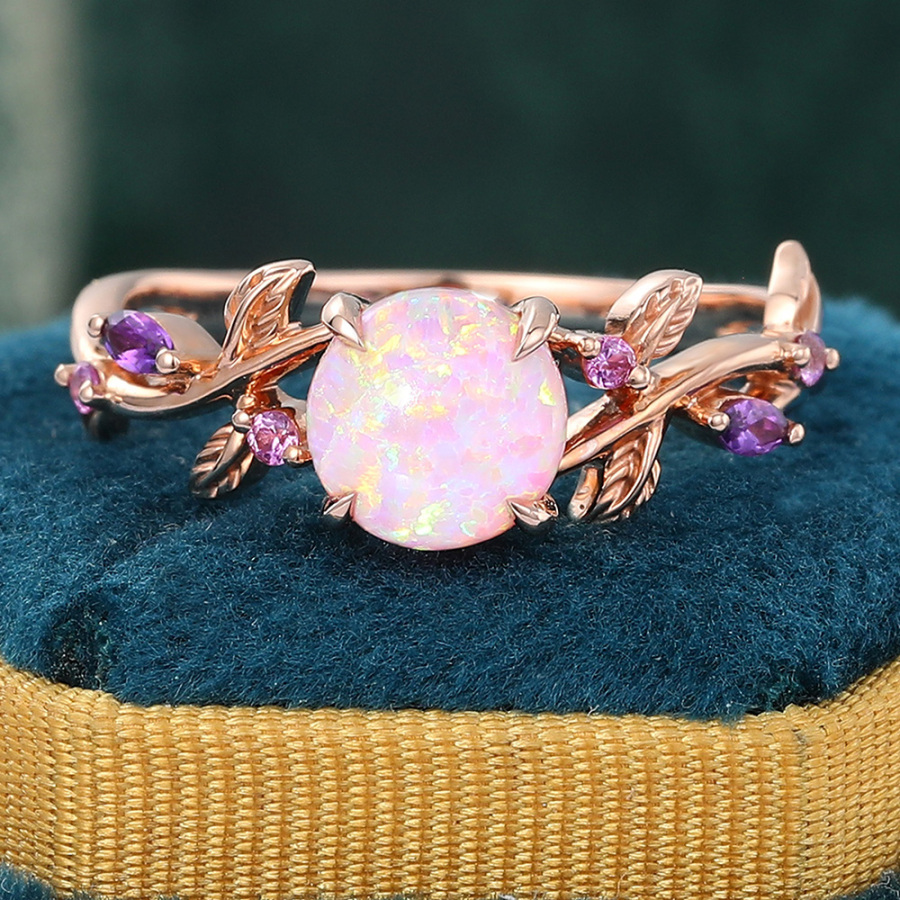
💖 Want the Opal Look with Unbeatable Value for Daily Wear?
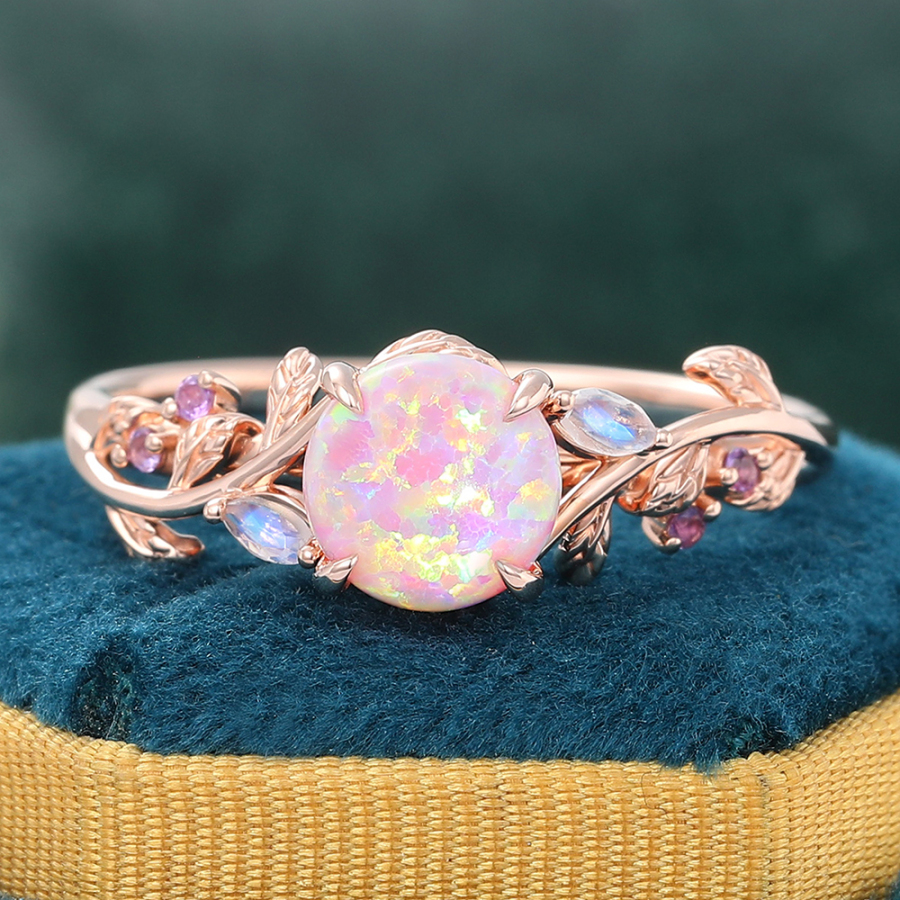
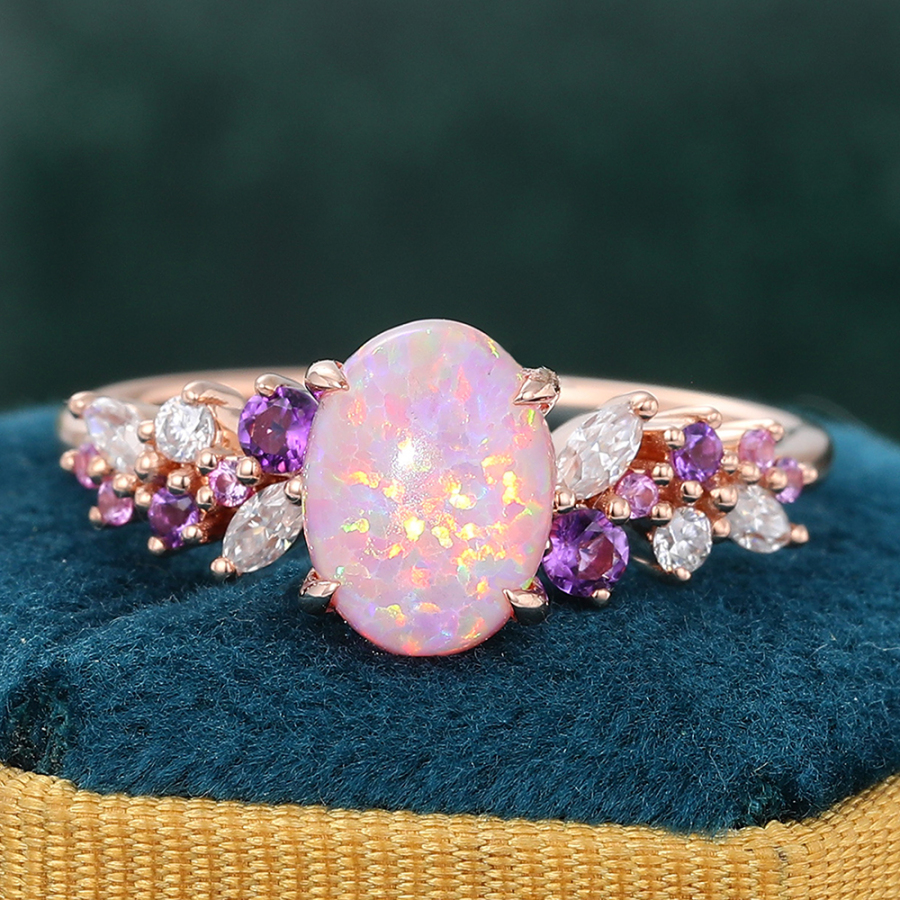
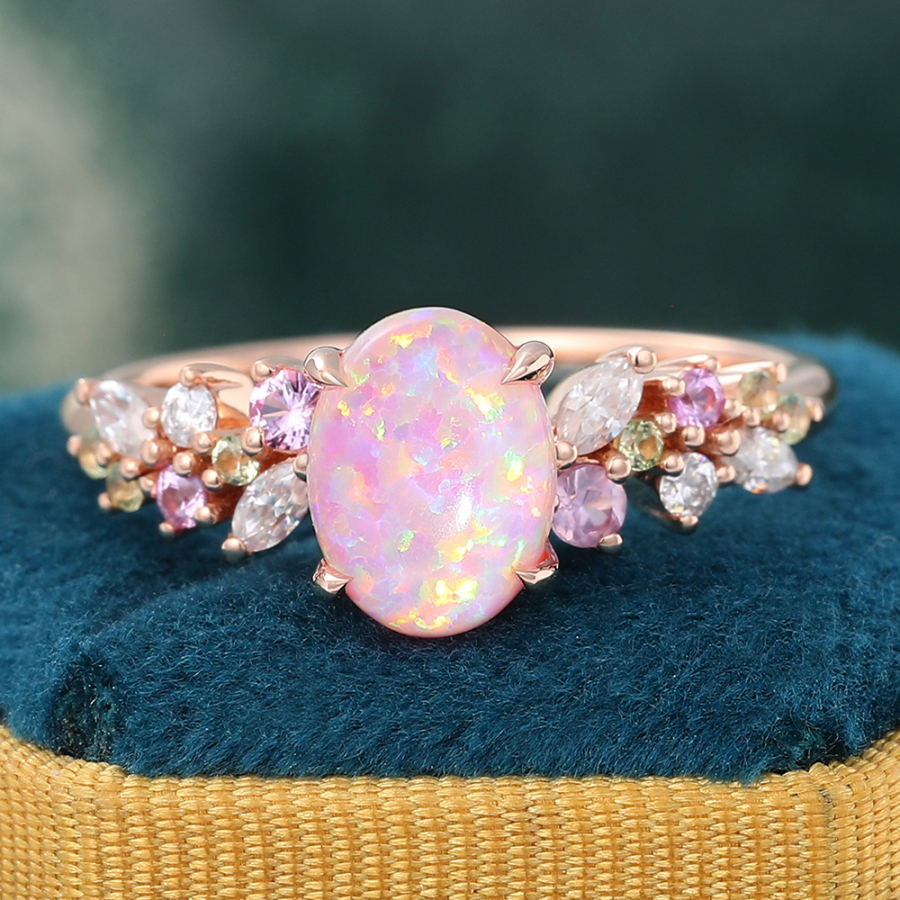
If you love the delicate, romantic hue of pink opal but need durability and affordability for everyday wear, our lab-created pink opal ring collection is the perfect solution.
You get the same stunning look with enhanced durability, all while staying within your budget. These pieces prove that you don't have to sacrifice beauty for practicality. Ideal for the modern, active individual, our lab-created opals offer worry-free elegance day in and day out. Explore the collection to find designs that fit seamlessly into your lifestyle.
Conclusion
The world of opals is rich in color and variety. Natural opals are irreplaceable natural wonders with lasting value, and synthetic opals offer stunning beauty, resilience, and accessibility.
Now that you understand the key differences, you are equipped to make a purchase you’ll be happy with for years to come. Your journey to the perfect opal starts here. Don't just admire the play of color-experience it! Explore Juyoyo's curated opal rings collection now to find the piece that speaks to you. Every opal in our collection comes with a clear origin guarantee, so you can shop with 100% confidence. Find your perfect opal today!
FAQs
Is Synthetic Opal Real?
Synthetic opal is neither plastic nor "fake" in a chemical sense. It is a lab-grown gemstone with virtually the same chemical composition (hydrated silica) as natural opal, but with a different structure.
How to Tell if Opal is Synthetic?
Synthetic opals often show a "lizard skin" or columnar pattern that looks more uniform than the random flashes found in natural opals. Under magnification, you’ll notice ordered color patches instead of irregular ones. Checking the weight and price can also help confirm authenticity.
Is Synthetic Opal Worth Anything?
Yes, synthetic opals have a genuine gem structure and are valued for their beauty, durability, and affordability. While they don’t have the rarity or investment potential of natural opals, synthetic opals are excellent choices for durable opal rings and for eco-conscious jewelry buyers.
Which is Better for Engagement Rings-Synthetic or Natural Opal?
Synthetic opals are more durable and resistant to cracking, making them ideal for everyday wear. However, natural opals offer unmatched uniqueness and heritage value, which is ideal for those who want a one-of-a-kind gemstone. The choice depends on your lifestyle and priorities.
Does Synthetic Opal Fade Over Time?
Generally, no. Unlike cheap plastics, high-quality lab-created opal is stable and will not fade if kept away from harsh chemicals.
Can I Wear My Synthetic Opal Ring in the Shower?
Although man-made opal jewelry is more durable than natural opal, we still recommend removing any jewelry before showering to protect the metal setting and maintain the polish of the stone.
Comment